

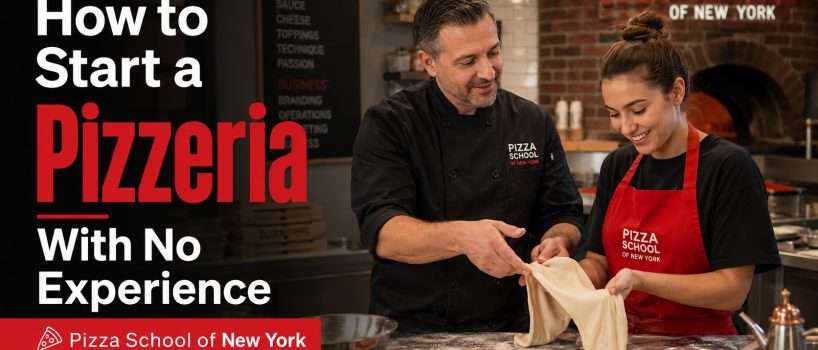
How to Start a Pizzeria With No Experience
 Learn how to start a pizzeria with no experience through hands-on professional pizza
If you want to start a pizzeria with no experience, you are not alone.
Many future pizzeria owners begin with a dream, a concept and a love of great pizza—but little or no professional pizza-making experience.
That does not mean you cannot build a great pizza business.
It does mean you should learn the craft, understand the numbers and develop a repeatable operating system before your restaurant depends on you knowing how to do it.
At the Pizza School of New York, we specialize in hands-on training for future pizzeria owners. Students learn one-on-one in a real restaurant environment while working directly with experienced pizza professionals.
The goal is not simply to teach you how to make one great pizza.
The goal is to help you understand how to build a pizza operation that can make great pizza again and again.
Can You Start a Pizzeria With No Experience?
Yes. Before you start spending money on a location or equipment, review our complete Pizzeria Startup Checklist to understand the major decisions you need to make before opening.
But there is a major difference between opening a pizzeria with no previous experience and opening one without preparation.
A new owner should understand enough about the product and operation to recognize great pizza, identify problems, control quality and eventually train employees.
You do not need ten years behind a pizza counter before you begin.
But before opening day, you should understand what properly fermented dough looks and feels like, how ingredients should be portioned, how your oven affects the finished pizza, how a pizza station should flow and how recipes can be repeated consistently by other people.
That knowledge becomes part of the foundation of your business.
Your First Investment Should Be Knowledge
It is easy to get excited about finding a location.
You can picture the sign outside, the dining room, the oven, the menu boards and customers walking through the door.
But the building does not make the pizza.
Your system does.
Before investing heavily in construction, equipment and a long-term lease, understand the product you plan to sell and how that product will actually be produced.
What style of pizza will define your business?
How will your dough be mixed, fermented, stored and managed?
What happens when dough does not behave the way you expected?
How many pizzas can your kitchen realistically produce during a rush?
How will toppings be prepared and portioned?
How will you train an employee to make the same pizza you make?
Those decisions affect far more than the food.
They influence your equipment, refrigeration, storage, kitchen layout, labor needs, menu and even the size and type of restaurant space you should consider.
Start a Pizzeria With No Experience by Building a Repeatable System
Learning a recipe is only the beginning.
A restaurant needs a repeatable production system.
One great pizza made by the owner is not enough.
Your business eventually needs to produce that pizza hundreds and thousands of times—with different employees, changing conditions and busy service periods—while maintaining the quality your customers expect.
That means learning not only recipes, but procedures.
Dough needs a procedure.
Sauce needs a procedure.
Cheese and toppings need portion standards.
Preparation needs a schedule.
The pizza station needs organization.
The oven needs to be understood.
Quality needs a standard.
When these pieces work together, you begin building a business instead of simply making pizza.
Learn Dough Before Dough Becomes Your Problem
Dough is the foundation of a pizza business.
It is also constantly changing.
Flour, water, yeast, salt, mixing time, finished dough temperature, refrigeration, fermentation time and room temperature can all affect the final result.
Following a recipe is not enough.
A future owner should understand why dough behaves the way it does.
What happens when the dough is too warm?
What happens when fermentation goes too long?
Why does dough sometimes snap back when you stretch it?
Why can today’s dough behave differently from yesterday’s batch?
Hands-on training allows you to mix dough, ball it, store it, stretch it, bake it and learn how to recognize problems.
That matters when you eventually have employees producing your product.
You need to know when something is right—and when something is wrong.
Build the Menu Around the Business You Want
A new pizzeria does not need to offer everything.
It needs to offer the right things exceptionally well.
A neighborhood slice shop operates differently from a full-service restaurant.
A brewery pizza concept may need a different menu and production strategy.
A takeout and delivery operation has different needs from a restaurant built around dine-in service.
A food truck or mobile pizza concept introduces another set of challenges.
Your menu should match your concept, customer, equipment and ability to execute the food consistently.
More menu items do not automatically create a stronger restaurant.
Sometimes they simply create more inventory, more waste, more preparation and more opportunities for inconsistency.
Build a menu your kitchen can execute—even when the restaurant is busy.
Understand Food Cost Before You Set Your Prices
Great pizza combined with poor numbers can still create a bad business.
Every pizza has a cost.
How much cheese is being used?
How much sauce?
What is the cost of the dough ball?
How much does each topping cost?
How much are employees actually putting on the pizza?
How much food is being wasted?
Standardized recipes and portions give you something you can cost, teach and control.
If one employee regularly puts two extra ounces of cheese on a pizza, it may not look like a serious problem.
Multiply that mistake by hundreds of pizzas and then by an entire year.
Small mistakes can become expensive habits.
Learning portion control, food cost, inventory and waste management is part of learning how to operate a professional pizza business.
Do Not Choose Equipment Just Because Someone Wants to Sell It to You
Equipment should serve the concept.
Not the other way around.
Your pizza style, expected volume, menu, bake temperature, kitchen layout, ventilation and available utilities should all influence your equipment decisions.
The oven is especially important.
A restaurant producing a few specialty pizzas has different requirements from a high-volume pizzeria producing hundreds of pizzas during busy service periods.
The same thinking applies to mixers, refrigeration, prep tables, dough storage and ventilation.
Buying equipment before understanding your production system can lock you into expensive decisions that may be difficult to change later.
Learn what you need the kitchen to accomplish first. Then design the equipment package around that goal.
Learn Inside a Real Restaurant Environment
There are thousands of pizza videos online.
Some of them are very useful.
But a video cannot feel your dough.
It cannot tell you that you are stretching incorrectly.
It cannot see that your workstation is poorly organized.
It cannot watch you load an oven.
It cannot correct your technique in real time.
And it cannot recreate the rhythm of working inside a real pizzeria.
At the Pizza School of New York, training is hands-on and one-on-one in a working restaurant environment.
You are not one student in a large classroom trying to keep up with everyone else.
The training can focus on you, your experience level, your questions and the pizza business you are preparing to open.
That is especially valuable for beginners.
You need repetition.
You need correction.
You need to ask questions.
And you need the opportunity to make mistakes before those mistakes happen in front of paying customers.
Future Pizzeria Owners Travel to New York for Hands-On Pizza Training
You do not have to live in New York to train at the Pizza School of New York.
Future pizzeria owners travel from across the United States and internationally for professional hands-on pizza training.
A student planning a pizzeria in Texas may have a completely different concept from someone opening in New Jersey.
Someone building a fast-casual operation may need a different production system from someone planning an artisan restaurant.
That is another advantage of one-on-one instruction.
The conversation can revolve around your business.
Your concept.
Your pizza.
Your menu.
Your equipment.
Your market.
Your goals.
We are not simply teaching pizza for the sake of teaching pizza.
We are helping future operators understand what it takes to produce great pizza professionally.
4-Day Pizzaiolo Course or 6-Day Master of Pizza Course?
The Pizza School of New York offers different levels of professional training depending on your goals.
Our 4-Day Pizzaiolo Course provides intensive hands-on training focused on developing practical pizza-making skills and professional production techniques.
For future owners who want to go deeper into the operational side of the business, the 6-Day Master of Pizza Course expands the training into areas such as menu development, par sheets, inventory, waste control, quality control and employee systems.
Which course is right for you depends on your existing experience and what you are preparing to build.
If you primarily need to master pizza production, the four-day program may be the right starting point.
If you are preparing to own and operate a pizzeria and want deeper business and operating knowledge, the Master of Pizza program may be more appropriate.
The important point is simple:
Learn before your restaurant is depending on you to already know.
Training Does Not Guarantee Success—But Guessing Is Not a Business Plan
No pizza school can guarantee that a restaurant will succeed.
Location matters.
Capital matters.
Rent matters.
Management matters.
Marketing matters.
Customer service matters.
Competition matters.
And execution matters every single day.
Professional training serves a different purpose.
It gives you an opportunity to enter the business with stronger technical skills, better systems and a clearer understanding of commercial pizza production.
Opening a restaurant will always involve risk.
The objective is to eliminate as many preventable mistakes as possible before they become expensive mistakes.
Before Signing the Lease, Learn What You Are Building
If you are still planning your pizzeria, this may be one of the best times to train.
Before the lease.
Before construction.
Before equipment orders.
Before hiring employees.
Before opening day.
Learn what kind of pizza you want to sell.
Learn how to make it.
Understand how it should be produced.
Build standardized recipes.
Understand your menu.
Understand food cost.
Understand your equipment requirements.
Think through your kitchen workflow.
Then build the restaurant around a system you understand.
If you are still in the planning stages, also review our Pizzeria Startup Checklist and Pizza Business Training Program.
These resources are designed to help future owners think through the many decisions that should be made before opening.
You can also read our student testimonials to learn about the experiences of people who have trained at the Pizza School of New York.
Ready to Start a Pizzeria With No Experience?
If you are serious about opening a pizza business, lack of experience does not have to stop you.
But it should motivate you to prepare.
You can start a pizzeria with no experience—but don’t start without learning the craft, understanding the numbers and developing a system.
Come to New York.
Get your hands in the dough.
Work the oven.
Learn the recipes.
Understand production.
Ask questions.
Talk about your concept.
Make your mistakes while you are learning—not after your doors are open and customers are waiting.
Then go home and build your pizza business with a much stronger foundation.
Pizza School of New York
One-on-One • Hands-On • Real Restaurant Training
Call 718-987-2422 to discuss your pizzeria concept and professional training options.
Frequently Asked Questions
Can I start a pizzeria if I have no pizza-making experience?
Yes. Previous professional pizza-making experience is not required to begin training. The important step is developing the practical skills and understanding required to produce pizza consistently before your business depends on those skills.
Should I go to pizza school before signing a restaurant lease?
Whenever possible, learning your product and production requirements early can help you make better-informed decisions about your menu, equipment, kitchen layout and restaurant space before committing substantial capital.
Is Pizza School of New York training hands-on?
Yes. Training is built around hands-on instruction in a working restaurant environment rather than simply watching demonstrations or learning from a traditional classroom.
Is the pizza training one-on-one?
Yes. One-on-one instruction is an important part of the Pizza School of New York training approach. It allows the instruction to focus on the student’s skill level, questions and future pizza concept.
What is the difference between the 4-Day Pizzaiolo Course and the 6-Day Master of Pizza Course?
The 4-Day Pizzaiolo Course focuses heavily on practical pizza-making skills and professional production. The 6-Day Master of Pizza Course goes deeper into areas relevant to future operators, including additional business and operating systems.
Can students attend from outside New York?
Yes. Future pizza professionals and pizzeria owners travel to New York for professional hands-on training. The skills learned can then be adapted to the student’s own market, ingredients, equipment and business concept.
What should I learn before opening a pizza place?
A future pizzeria owner should understand dough production, fermentation, pizza preparation, ingredient portioning, commercial oven operation, menu development, food cost, kitchen workflow, equipment requirements, quality control and employee systems.
Where should I start if I am still planning my pizzeria?
Start by defining your concept and learning the product. Professional training, a detailed startup plan and a realistic understanding of food cost, equipment, location and workflow can help you make better decisions before committing to construction and opening expenses.