

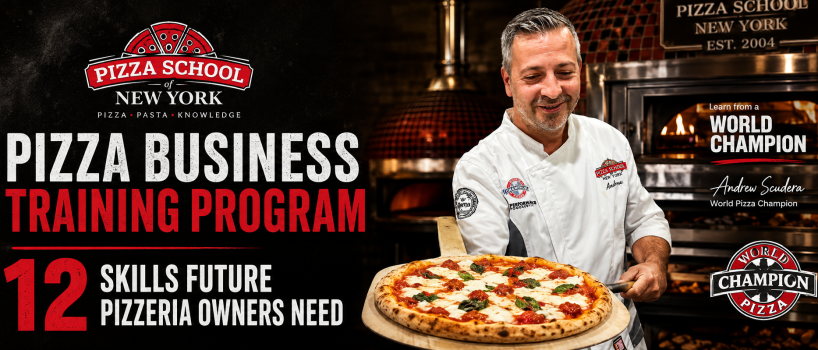
Pizza Business Training Program | Pizza School NY
Choosing the right pizza business training program is one of the most important steps future pizzeria owners can take before signing a lease, purchasing equipment or hiring employees. Opening a successful pizzeria requires more than a good recipe and a commercial pizza oven. Future owners must understand dough production, ingredient preparation, kitchen workflow, food cost, menu development, employee training and live restaurant production.
That is why choosing the right pizza business training program can be one of the most important steps you take before signing a lease, purchasing equipment or hiring a team.
A recreational pizza class may teach you how to make a few pizzas. A professional program designed for future business owners should teach you how to build a repeatable pizza operation.
The goal is not simply to make one great pizza. The goal is to create excellent pizza consistently while controlling quality, speed, labor and food cost.
Why a Pizza Business Training Program Is Different from a Pizza-Making Class
Many pizza classes are designed for home cooks, tourists or people looking for an enjoyable culinary experience. These classes can be fun, but they are not necessarily designed to prepare someone to operate a commercial pizzeria.
A future restaurant owner needs to learn what happens when the business must produce dozens or hundreds of pizzas while maintaining the same dough, portion sizes, bake quality and presentation.
Professional pizza business training should address both sides of the operation:
- The craft of making excellent pizza
- The systems required to operate a successful pizza business
Students should personally make dough, prepare sauces, stretch pizzas, work with ingredients, operate commercial ovens and experience a real production environment.
Watching demonstrations is not enough. Building confidence requires repetition, correction and hands-on practice.
What a Pizza Business Training Program Should Teach
Before choosing a pizza school, study what the program actually includes.
Does the course focus only on recipes, or does it also teach production, kitchen organization, food cost, inventory and employee training?
Will you personally work at the pizza station, or will you spend most of the course watching an instructor?
The following 12 skills should be considered when comparing professional pizza training programs.
1. Dough Science and Fermentation
Dough is the foundation of a pizza business.
A professional program should teach how flour, water, yeast, salt, mixing time, dough temperature and fermentation work together.
Future owners should understand:
- Different flour types
- Hydration percentages
- Yeast selection
- Finished dough temperature
- Mixing procedures
- Cold fermentation
- Dough-ball sizing
- Proofing
- Storage
- Dough troubleshooting
Following a written recipe is only the beginning.
An owner must understand why dough behaves differently when the temperature changes, a new flour is introduced, fermentation time is adjusted or an employee makes a production mistake.
When you understand the science, you are better prepared to correct problems instead of throwing away an entire batch.
2. Commercial Dough Production
Making six dough balls at home is very different from preparing enough dough for a busy restaurant.
Commercial dough production requires planning, accurate scaling and a dependable schedule.
Training should teach you how to determine:
- How much dough to produce
- When each batch should be mixed
- How to scale recipes accurately
- How dough should be divided and stored
- How to rotate dough inventory
- How to prepare for weekends and busy periods
- How to avoid shortages and overproduction
The system must eventually be clear enough for trained employees to reproduce without the owner standing beside them.
3. Stretching and Forming Pizza Consistently
Opening dough must become a repeatable skill.
Every pizza should have the correct diameter, thickness, rim structure and weight. Uneven stretching affects appearance, bake time, texture and food cost.
Students should practice correcting common problems such as:
- Thin centers
- Thick sections
- Uneven crusts
- Dough tearing
- Dough sticking
- Excess bench flour
- Dough snapping back
- Misshapen pizzas
Repetition is essential. A student may need to open dozens of dough balls before the movement becomes natural and consistent.
4. Sauce, Cheese and Topping Preparation
Ingredients must be selected for flavor, appearance, bake performance and cost.
A professional program should teach students how to:
- Choose and evaluate tomatoes
- Prepare balanced pizza sauces
- Select cheeses and cheese blends
- Prepare vegetables correctly
- Portion meats and premium toppings
- Prevent ingredients from releasing excess moisture
- Apply toppings evenly
- Finish pizzas after baking
The most expensive ingredient is not automatically the best ingredient for every concept.
An owner must consider flavor, availability, consistency, portion size and how each ingredient performs in the oven.
5. Pizza Styles and Concept Development
Learning several pizza styles helps a future owner decide which products best fit the planned restaurant.
Training may include:
- New York-style pizza
- Brick oven pizza
- Grandma pizza
- Sicilian pizza
- Specialty pizzas
- Calzones
- Pizza rolls
- Brick oven breads
- Dessert pizzas
The goal is not to place every possible item on the menu.
The goal is to understand different products well enough to build a focused concept that customers will remember and employees can execute consistently.
A slice shop, brewpub, full-service restaurant, fast-casual concept and mobile pizza operation may each require a different menu and production system.
6. Commercial Pizza Oven Operation
The oven is the center of the pizza operation.
Students should learn more than how to place a pizza inside and wait for it to bake.
Professional oven training should include:
- Floor temperature
- Chamber temperature
- Heat recovery
- Pizza placement
- Rotation
- Bake time
- Managing multiple pizzas
- Managing different products
- Preventing burned bottoms
- Correcting pale or uneven bakes
- Maintaining production during busy periods
Every oven has its own operating characteristics.
A trained operator must understand how dough formulation, pizza size, topping load, oven temperature and production volume affect the final bake.
Why a Pizza Business Training Program Must Include Live Production
Pizza changes when the pressure increases.
Making one pizza in a quiet classroom does not recreate what happens when multiple orders arrive at once, the make line is full, the oven is loaded and customers are waiting.
Live production helps students learn:
- How to organize the station before service
- How to read and prioritize orders
- How to communicate with the team
- How to stage pizzas before baking
- How to manage oven capacity
- How to maintain consistency during a rush
- How to keep the station clean and stocked
- How to recover when production falls behind
These are difficult lessons to learn from a book or online video.
Real production experience helps connect every individual skill into one complete operating system.
A professional pizza business training program should connect individual pizza-making skills to the realities of commercial restaurant production. Students must understand how dough, preparation, order flow, oven capacity and employee communication work together during service.
7. Kitchen Layout and Production Workflow
An inefficient kitchen increases labor, slows service and creates unnecessary stress.
Future owners should understand how ingredients and finished products move through the restaurant.
A basic pizza workflow may include:
- Receiving and storage
- Dough production
- Ingredient preparation
- Pizza assembly
- Pre-oven staging
- Baking
- Cutting, finishing and expediting
- Cleaning and restocking
Each station should support the next station.
Employees should not have to repeatedly cross the kitchen, search for tools or walk around other employees to complete basic tasks.
Learning workflow before approving a restaurant design can help an owner avoid costly layout and equipment mistakes.
8. Recipe Standardization
A successful recipe must be repeatable.
It should be written clearly enough for a trained employee to produce the same pizza when the owner is not present.
Standardized recipes should include:
- Ingredient weights
- Dough-ball weights
- Mixing procedures
- Finished dough temperatures
- Fermentation times
- Sauce portions
- Cheese portions
- Topping portions
- Pizza build order
- Baking instructions
- Finishing procedures
- Reference photographs
Statements such as “use a handful of cheese” or “add a little sauce” create inconsistency.
Written standards make training, quality control, food costing and expansion easier.
9. Portion Control and Food Cost
A popular pizza can still lose money when portions are not controlled.
Future owners should understand the cost of every component:
- Dough
- Sauce
- Cheese
- Meat
- Vegetables
- Garnishes
- Packaging
Cheese and premium toppings should be weighed while recipes are being developed.
Once the correct portion is established, employees should be trained to reproduce it consistently.
Portion control does not mean reducing quality. It means serving the correct product every time while protecting the restaurant’s margins.
10. Par Sheets, Inventory and Waste Control
A busy restaurant needs systems that tell employees what to prepare, how much to prepare and when to prepare it.
A business-focused program should introduce:
- Daily par sheets
- Prep lists
- Opening checklists
- Closing checklists
- Inventory rotation
- Ordering procedures
- Waste tracking
- Production forecasting
- Quality-control inspections
Without these systems, a restaurant may prepare too much product, run out during service or allow ingredients to expire.
Good inventory control protects freshness, cash flow and consistency.
11. Menu Development
A menu must be exciting for customers and practical for the kitchen.
Future owners should evaluate:
- The restaurant’s core pizza style
- Target customers
- Oven capacity
- Ingredient availability
- Ingredient crossover
- Preparation time
- Labor requirements
- Food cost
- Takeout performance
- Delivery performance
- Local preferences
An oversized menu can create excessive inventory, waste, slow ticket times and inconsistent execution.
A smaller menu of well-designed products can often provide more value than a large menu filled with items that are difficult to prepare or rarely ordered.
Every menu item should have a clear purpose.
12. Employee Training and Quality Control
The owner will eventually need other people to reproduce the same product.
A professional training program should help future owners understand how to train employees using:
- Written recipes
- Demonstrations
- Repetition
- Portion charts
- Product photographs
- Station checklists
- Opening and closing procedures
- Quality-control standards
- Manager inspections
The business should not depend entirely on one person knowing how everything is done.
Documented systems help new employees learn faster and give managers a clear standard for evaluating the finished product.
Pizza Business Training Program for Students Across the United States
Future pizzeria owners travel for professional training because the right program may not be available close to home.
An intensive course can be especially valuable when the instruction is customized around the student’s planned restaurant.
Before attending, students should be prepared to discuss:
- Their proposed concept
- Planned pizza styles
- Restaurant size
- Expected production
- Target market
- Proposed menu
- Equipment under consideration
- Opening timeline
- Previous restaurant experience
This information helps instructors connect the training to the student’s actual business goals.
A future slice-shop owner may need a different production strategy from someone planning a brewery, full-service restaurant, fast-casual concept or mobile pizza business.
International Pizza Business Training
International students may face additional challenges when they return home.
Flour, cheese, tomatoes, ovens, fuel sources, electrical requirements, measurements and customer preferences may differ from those available in New York.
That is why international students must learn principles instead of simply memorizing recipes.
Understanding baker’s percentages, dough temperature, fermentation, ingredient function, portion control and production workflow makes it easier to adapt a pizza concept to another country.
International students should also research:
- Local flour specifications
- Available cheese and tomato products
- Import restrictions
- Restaurant equipment availability
- Local utility requirements
- Local measurements and temperatures
- Customer expectations
- Local food and business regulations
A strong foundation allows the student to make informed adjustments without losing the quality and identity of the product.
How to Choose a Pizza Business Training Program
Before enrolling, ask the school specific questions.
Is the training genuinely hands-on?
You should personally make dough, stretch pizzas, prepare ingredients and operate commercial ovens.
Is the program designed for business owners?
A future pizzeria owner needs training in production, food cost, workflow, menu development and employee systems—not only pizza recipes.
Will the course address your planned concept?
Training should connect to your goals, whether you are opening a slice shop, restaurant, brewery, food truck, takeout operation or another pizza concept.
Will you work in a real restaurant environment?
Live production provides valuable experience that cannot be fully recreated in a traditional classroom.
Will you receive recipes and training materials?
Written materials make it easier to repeat what you learned and train employees after returning home.
Does the program include support after graduation?
Questions often arise while selecting equipment, testing ingredients, training staff and preparing for opening.
Why Future Pizzeria Owners Choose the Pizza School of New York
The Pizza School of New York provides private, hands-on pizza training in a working restaurant environment.
Students work directly with experienced pizza professionals and receive training that can be customized around their planned business.
No previous pizza-making experience is required.
The school offers a four-day professional Pizzaiolo course and an advanced six-day program for students who want additional training in operations, menu development, par sheets, inventory, quality control and management systems.
Classes are offered throughout the year based on availability. The school accepts one concept at a time, allowing the instruction to remain focused on the student or business partners attending together.
Students travel from across the United States and around the world to learn professional pizza production and prepare for their own restaurant concepts.
Learn the Craft Before Building the Business
An expensive oven, attractive dining room and strong location cannot compensate for inconsistent pizza or a poorly organized operation.
Learn the product first.
Understand the production system.
Build standardized recipes.
Develop a menu your kitchen can execute.
Learn how to control quality, portions and inventory.
Then invest in the location, equipment and staff required to bring the concept to life.
Professional training cannot guarantee that every restaurant will succeed. However, it can help future owners approach the business with stronger skills, better systems and a clearer understanding of what commercial pizza production requires.
To discuss your pizza concept and determine which training program matches your goals, contact the Pizza School of New York at 718-987-2422.
Frequently Asked Questions About Pizza Business Training
Do I need restaurant experience before attending pizza school?
No. A professional program can help beginners, chefs and experienced restaurant operators. Pizza School of New York does not require previous pizza-making experience, but students should be prepared for intensive hands-on work.
Can a pizza business training program help me open a pizzeria?
A professional program can help you understand dough production, ovens, workflow, recipes, menu development, portion control and operating systems. Training cannot guarantee business success, but it can help you make better-informed decisions before opening.
Is hands-on pizza training better than an online course?
Online courses can provide useful background information. However, an online instructor cannot physically correct your stretching technique, evaluate your dough, observe your workstation habits or help you operate an oven during live production.
Can international students attend the Pizza School of New York?
Yes. The school works with students from the United States and other countries. International students should provide information about the ingredients, equipment and measurements available in their home market so the training can be connected to their planned concept.
What is the difference between the four-day and advanced course?
The four-day Pizzaiolo course focuses on hands-on pizza production, including dough, sauces, toppings, pizza styles and commercial oven operation. The advanced six-day course adds more detailed operational training, such as menu development, par sheets, inventory, waste control, quality control and employee training.